What causes overuse injuries in long-distance running?
If you’ve been running long distances for a while, chances are you’ve experienced an injury at some point. Each year, around 50% of runners report being injured, and an even greater proportion have sustained a running-related injury (RRI) over their lifetime.
In many cases, these injuries aren’t the result of a single event, but rather a gradual overload of muscles, tendons, and bones, often leading to reduced training, unplanned rest, or, in more severe cases, medical intervention that can affect not only running but also other areas of daily life.
Given how common RRIs are and how impactful they can be, it’s critical to understand how these injuries develop and what factors contribute to them.
What is an overuse injury?
Not much has changed since the 1990s, when a review of epidemiological studies on running-related injuries found that 50-75% of the injuries arise from consistent repetition of the same movement and can therefore be classified as overuse injuries (van Mechelen, 1992). Fast forward to 2025, and a cohort study reported that 72% of all RRIs arise from regular overload of joints, muscles, or bones over a period of time (Frandsen et al., 2025).
“72% of all running related injuries arise from regular overload of joints, muscles, or bones over a period of time. ”
In contrast, traumatic or acute injuries, such as muscle strains, ankle sprains, or blisters, arise from one event and are considerably less common among runners. Bone fractures, in turn, can be either acute (a sudden, high-force impact) or related to overuse (stress fractures resulting from repeated overload or inadequate diet). Often, injuries, first considered acute, are actually the result of repeated mechanical stress on the tissue that, at one point, is too much for it to handle (Warden et al., 2021).
Most overuse injuries are lower extremity injuries, with the knee being the most vulnerable part of the body. Patellofemoral pain syndrome (PFPS), or "runner's knee”, is often cited as the most frequent overuse injury, while Achilles tendinopathy and medial tibial stress syndrome, or shin splints, follow in a close second and third (Francis et al., 2019).
How overuse injuries develop
The mechanism behind the development of overuse injuries is simple but often difficult to detect in early stages. It all starts with a workout. If the training stimulus is sufficiently strong, it induces muscle fiber damage that subsequently produces inflammation (hello soreness), creates fatigue, and initiates recovery (Beardsley, 2022).
Each muscle group has a different recovery rate - the time necessary for the damaged muscle to be repaired and come back stronger through the process of supercompensation (Beardsley, 2022). Beginner runners need more time for recovery, as the body is not used to handling workout stress. The same goes for older athletes (35+), and those having just completed an intense workout, having missed a post-workout meal, or who have skipped quality sleep.
If workouts keep piling on one by one without sufficient rest in between over an extended period, the muscle keeps getting damaged until it cannot sustain the load any longer and becomes painful.
“The key to avoiding running overuse injuries lies in workout planning and finding a balance between training volume and intensity, acute and accumulated (or chronic) workload.”
For cyclical sports like running, the risk of developing overuse injuries is much higher than for team sports because the same structures are put under stress in every single running workout (Franco et al., 2021). The art is in workout planning and finding a balance between training volume and intensity, acute and accumulated (or chronic) workload.
How to avoid overuse injuries?
The key to avoiding overuse injuries lies in managing training load. One way to do this is by monitoring both running volume and intensity. While the traditional “10% rule” once guided week-to-week progression, recent thinking places more emphasis on avoiding sudden spikes, especially in the distance or intensity of individual sessions, as a more reliable way to ensure sustainable progress.
When a single run is significantly longer than what your body is used to, the risk of overuse injuries increases. Research suggests that increasing the distance of a single run by 10-30% compared to your longest run in the previous 30 days already raises injury risk substantially, and doubling that distance can push the risk even higher (Schuster Brandt Frandsen et al., 2025). While injuries don’t occur overnight, consistently repeating these spikes over time can lead to problems.
“Increasing the distance of a single run by 10-30% compared to your longest run in the previous 30 days already raises injury risk substantially.”
Most sports watches provide an indication of your training load and its intensity. While useful, these algorithms don’t always fully reflect your individual context and should therefore be taken as a general guideline rather than an absolute measure. For example, an easy long run might feel like a 3 out of 10 effort and stay within zone 2, resulting in a relatively low training load score. Yet, it can still place significant stress on your body and require longer recovery.
Tools like KULG go a step further by helping you understand how your training load evolves over time, combining performance data with how your body feels. KULG highlights spikes in load, drops in recovery, and changes in readiness, helping runners avoid overtraining and stay consistent. It also flags when individual runs increase too sharply (e.g. by more than 10-30%) compared to your recent training history.
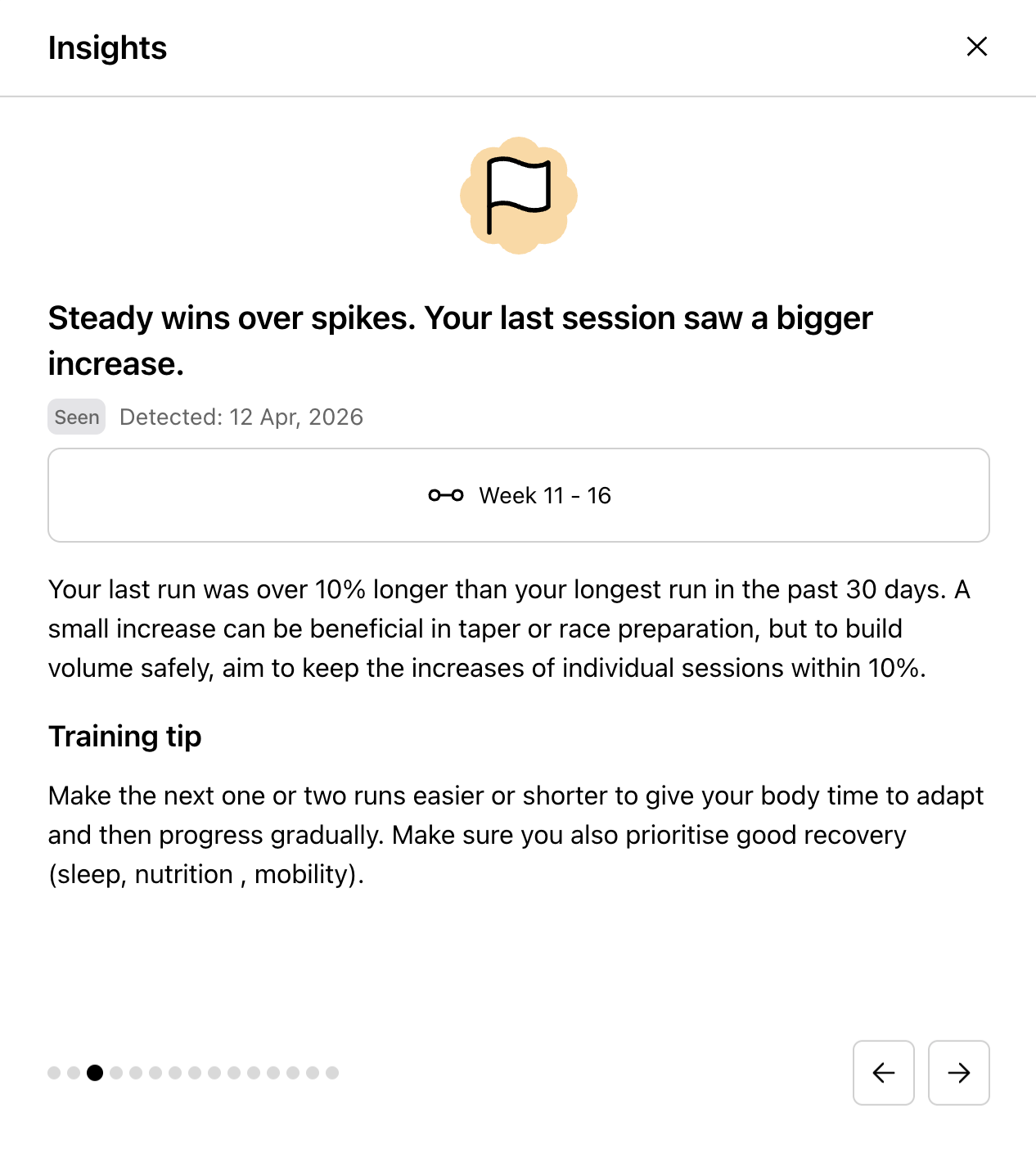
KULG insights highlight spikes in running volume or intensity to help runners avoid overuse injuries
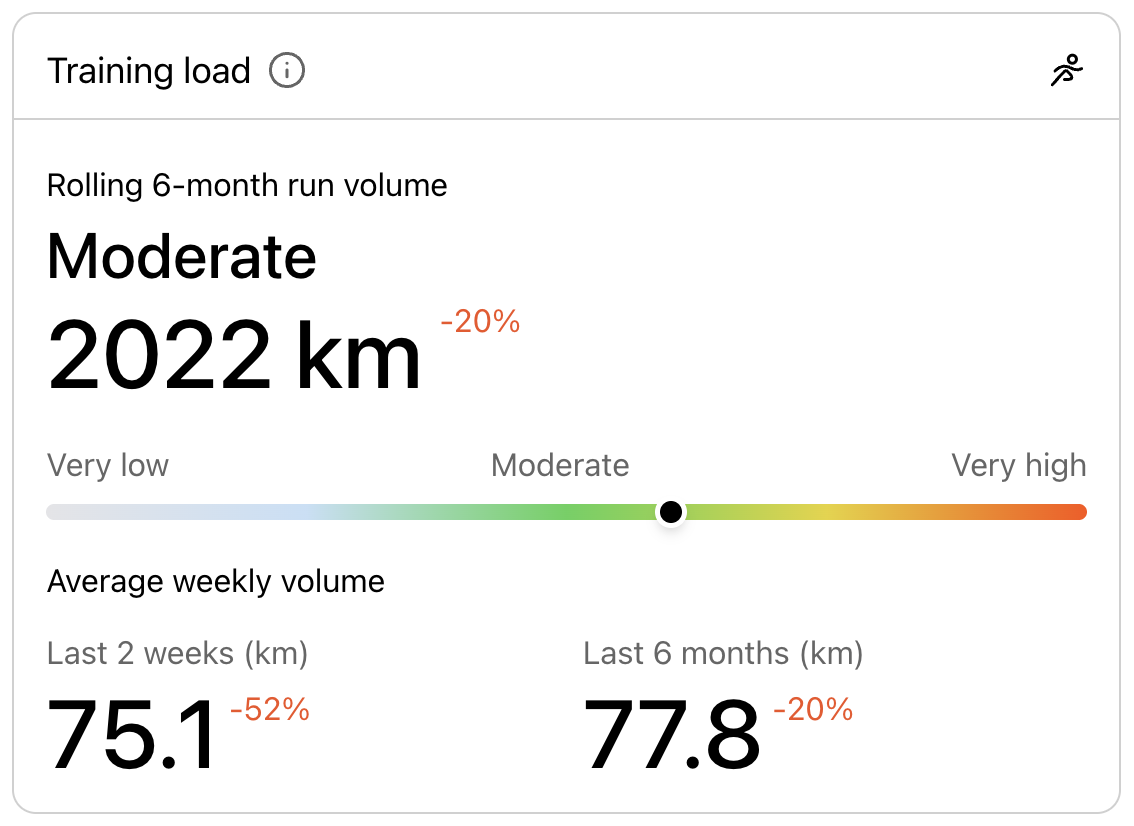
KULG also indicates run training load by comparing your recent 2-week running distance to your 6-month average weekly volume.
What causes overuse injuries in runners?
“Too much, too soon” is commonly cited as an explanation for the development of overuse injuries. But there’s more to the story than just the running volume.
Different demographic, training-related, and health-related factors predispose long-distance runners to sustaining overuse injuries. Usually, it’s an interaction among several of these factors rather than just the effect of one:
Demographic characteristics – above-normal body mass index (>25), due to increased stress on muscles and joints in every step, and 0–2 years of prior running experience increase the risk of developing overuse injuries (van der Worp et al., 2015).
Training-related factors – in addition to a sharp increase in weekly and single-session running volume, high workout frequency without sufficient rest in between, as well as running in worn-out shoes lead to overuse injuries (Schuster Brandt Frandsen et al., 2025).
Health and lifestyle factors – previous injuries pose the most risk for developing overuse injuries. Also, the absence of cross-training (concurrent activities without axial loading) promotes muscle imbalances that lead to overcompensation and overloading (Correia et al., 2024).
Biomechanical factors – runners with hyperpronation, leg length discrepancy, heelstrike, and/or weak hip adductors, leading to increased knee internal rotation at landing, put more stress on musculoskeletal tissues and can sooner develop overuse injuries (Willwacher et al., 2022).
Conclusion
Overuse injuries can bring disappointment, a sense of helplessness, and even anger. After all, they’re the reason you have to cut back on training or even stop running completely for some time. For people for whom long-distance running is part of their lifestyle, not being able to run can be more painful than the aching muscle or tendon itself.
Remember, overuse injuries don’t appear out of nowhere. They develop over time when you want to run too far, too fast, but your body isn’t ready for it. It’s essential not to ignore your weaknesses and address pain points when they appear. Listen to your body when it asks for rest, and be mindful of your running form. With the right tools to track your workload, you can significantly reduce your risk of overuse injury.
References
Beardsley, C. Recovery Rates of Muscle Groups. Available:https://www.patreon.com/posts/recovery-rates-62989969
Correia, C. K., Machado, J. M., Dominski, F. H., de Castro, M. P., de Brito Fontana, H., & Ruschel, C. (2024). Risk factors for running-related injuries: An umbrella systematic review. Journal of sport and health science, 13(6), 793–804. https://doi.org/10.1016/j.jshs.2024.04.011
Fields, K. B., Sykes, J. C., Walker, K. M., & Jackson, J. C. (2010). Prevention of running injuries. Current sports medicine reports, 9(3), 176–182. https://doi.org/10.1249/JSR.0b013e3181de7ec5
Francis, P., Whatman, C., Sheerin, K., Hume, P., & Johnson, M. I. (2019). The Proportion of Lower Limb Running Injuries by Gender, Anatomical Location and Specific Pathology: A Systematic Review. Journal of sports science & medicine, 18(1), 21–31.
Franco, M. F., Madaleno, F. O., de Paula, T. M. N., Ferreira, T. V., Pinto, R. Z., & Resende, R. A. (2021). Prevalence of overuse injuries in athletes from individual and team sports: A systematic review with meta-analysis and GRADE recommendations. Brazilian journal of physical therapy, 25(5), 500–513. https://doi.org/10.1016/j.bjpt.2021.04.013
Frandsen, J. S. B., Simonsen, N. S., Hulme, A., Jacobsen, J., & Nielsen, R. O. (2025). A Paradigm Shift in Understanding Overuse Running-Related Injuries: Findings From the Garmin-RUNSAFE Study Point to a Sudden Not Gradual Onset. Jospt Open, 3(1), 85-92. https://doi.org/10.2519/josptopen.2024.0075
Qin, W., Li, R., & Chen, L. (2025). Acute to chronic workload ratio (ACWR) for predicting sports injury risk: a systematic review and meta-analysis. BMC sports science, medicine & rehabilitation, 17(1), 285. https://doi.org/10.1186/s13102-025-01332-x
Schuster Brandt Frandsen, J., Hulme, A., Parner, E. T., Møller, M., Lindman, I., Abrahamson, J., Sjørup Simonsen, N., Sandell Jacobsen, J., Ramskov, D., Skejø, S., Malisoux, L., Bertelsen, M. L., & Nielsen, R. O. (2025). How much running is too much? Identifying high-risk running sessions in a 5200-person cohort study. British journal of sports medicine, 59(17), 1203–1210. https://doi.org/10.1136/bjsports-2024-109380
van der Worp, M. P., ten Haaf, D. S., van Cingel, R., de Wijer, A., Nijhuis-van der Sanden, M. W., & Staal, J. B. (2015). Injuries in runners; a systematic review on risk factors and sex differences. PloS one, 10(2), e0114937. https://doi.org/10.1371/journal.pone.0114937
van Mechelen W. (1992). Running injuries. A review of the epidemiological literature. Sports medicine (Auckland, N.Z.), 14(5), 320–335. https://doi.org/10.2165/00007256-199214050-00004
Warden, S. J., Edwards, W. B., & Willy, R. W. (2021). Preventing Bone Stress Injuries in Runners with Optimal Workload. Current osteoporosis reports, 19(3), 298–307. https://doi.org/10.1007/s11914-021-00666-y
Willwacher, S., Kurz, M., Robbin, J., Thelen, M., Hamill, J., Kelly, L., & Mai, P. (2022). Running-Related Biomechanical Risk Factors for Overuse Injuries in Distance Runners: A Systematic Review Considering Injury Specificity and the Potentials for Future Research. Sports medicine (Auckland, N.Z.), 52(8), 1863–1877. https://doi.org/10.1007/s40279-022-01666-3