The most common running injuries caused by overuse
As with most things in life, consistency is key to progress in long-distance running. If you want to run faster and farther, you need to run more. There’s no shortcut, no magic pill that can save you hours of training.
But more time on your feet also means more stress on your body, and as your goal distance and training volume increase, so does your risk of getting injured. Often, it’s not a matter of discipline or motivation, but of how well your body can handle the mileage.
While some injuries, like ankle sprains, can come unexpectedly, most running-related injuries (RRIs) result from a series of poor decisions and overload. Let’s look at the most common overuse injuries that runners face.
What causes running overuse injuries?
Overuse injuries arise from repeated mechanical stress on tendons, joints, muscles, or bones. One or a few instances of increased load won’t do much damage, but when it accumulates, and the tissue isn’t given enough time to rest and repair, eventually, it’s unable to recover from the impact.
Think of this mechanism like a rope under repeated tension. At first, it holds. Over time, individual fibers begin to fray. Eventually, enough fibers fail that the rope can no longer tolerate the load.
“Epidemiological research has consistently shown that the vast majority of all RRIs fall into the overuse category.”
Top running injuries
Cyclical sports are known for placing mechanical load on the same tissues over and over again, which is why overuse injuries are so common in these activities. In long-distance running, it’s the lower extremities that need to bear and absorb most of the stress, and consequently, the legs are the most commonly injured part of the runner’s body.
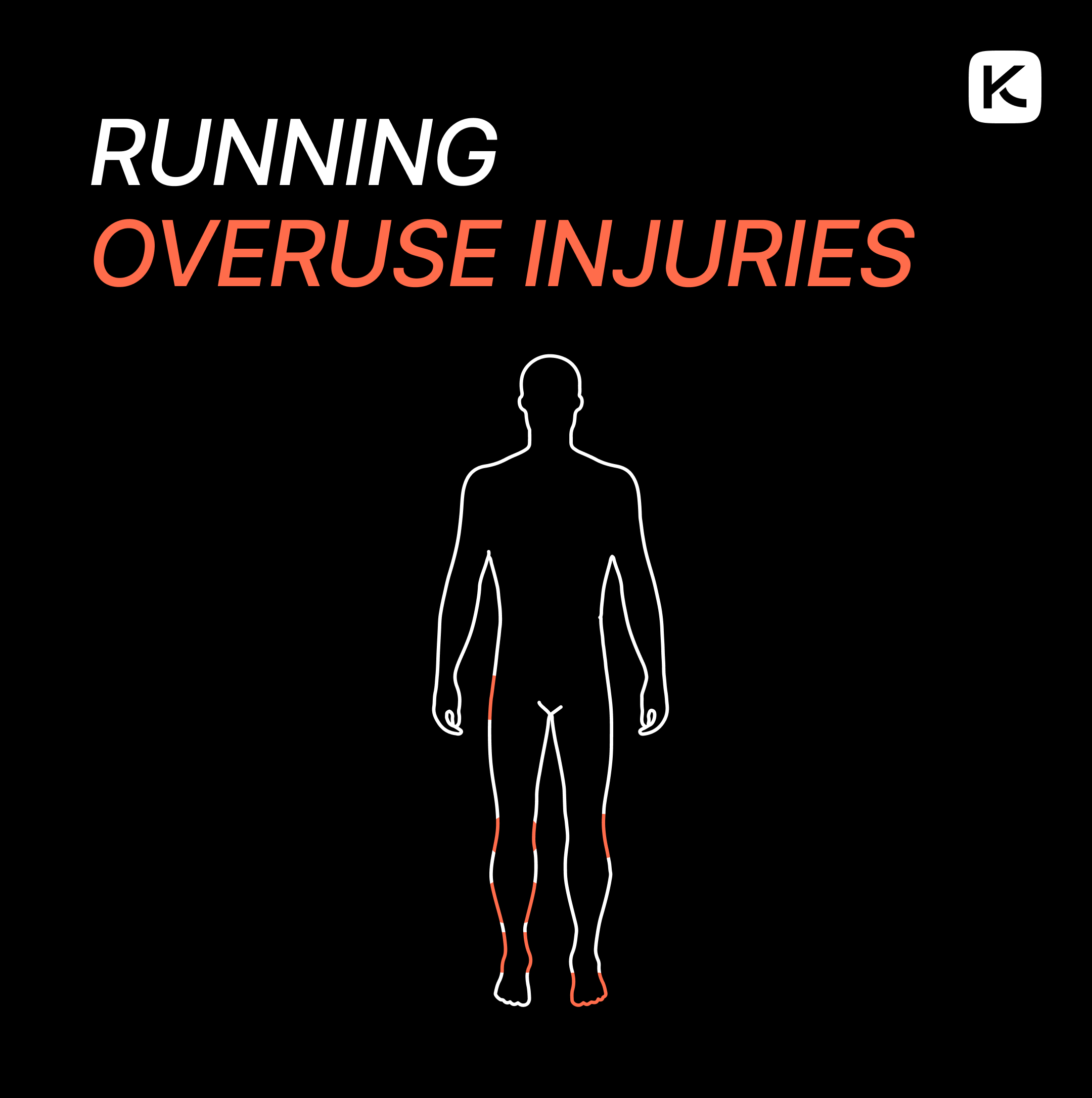
Repeated mechanical stress, when applied in the wrong doses - too much, too soon, or too intense - is the main cause of running overuse injuries.
However, in the right amount and progression, the same mechanical stress from running strengthens bones, tendons, and connective tissue, improving overall durability and resilience.
Systematic reviews (Kakouris et al., 2021; Francis et al., 2019) report different incidence rates, but they all agree that the following four are the most common running-related overuse injuries:
Achilles tendinopathy
Pain, stiffness, swelling, and reduced function of the Achilles tendon (which connects the lower leg muscles to the heel bone), often combined with heel pain that intensifies after activity. It usually occurs as a result of a sudden modification in training routines (Moonot & Dakhode, 2024).
Medial tibial stress syndrome
Also known as “shin splints”; pain along the shinbone. It’s a common injury among beginner runners who undergo a rapid increase in exercise frequency, duration, or intensity, or who run in worn-out or unsupportive footwear. Flat feet and muscular imbalances in the lower leg may also be contributing factors (Bhusari & Deshmukh, 2023).
Patellofemoral pain syndrome
Also known as “runner’s knee”; pain under or around the kneecap that worsens with knee flexion. It’s most often linked to overuse and muscular imbalances, such as weak hips and quadriceps and tight hamstrings (Waryasz & McDermott, 2008).
Plantar fasciitis
Sharp, stabbing pain in the heel and around the arch, caused by repetitive strain on the plantar fascia, the connective tissue supporting the arch. It typically occurs in runners with flat or highly arched feet, reduced ankle flexibility, or excessive pronation/supination (Mørk et al., 2023).
Conclusion
Epidemiological research has consistently shown that the vast majority of all RRIs fall into the overuse category (Frandsen et al., 2025). Unlike acute injuries, where the cause-and-effect relationship is clear, overuse injuries develop over time through a mix of factors, and the final tipping point often can’t be easily determined.
Nevertheless, it is possible to recognize the early signals that lead to running overuse injuries and train in a way that minimizes the risk of injury. We will explore this further in the next article on running injuries. This is where tools like the KULG App come in, supporting runners by helping both athletes and coaches not only improve performance but also stay consistent and healthy to win in the long run.

The right stress makes you stronger. The wrong dose causes injury.
KULG helps you train with the right load at the right time, so you can progress without breaking down.
References
Bhusari, N., & Deshmukh, M. (2023). Shin Splint: A Review. Cureus, 15(1), e33905. https://doi.org/10.7759/cureus.33905
Clansey, A. C., Hanlon, M., Wallace, E. S., Nevill, A., & Lake, M. J. (2014). Influence of tibial shock feedback training on impact loading and running economy. Medicine and science in sports and exercise, 46(5), 973–981. https://doi.org/10.1249/MSS.0000000000000182
Colebatch, E. A., Fuller, J. T., Mantzioris, E., & Hill, A. M. (2025). Diet, risk of disordered eating and running-related injury in adult distance runners: A systematic review and meta-analysis of prospective cohort studies. Journal of science and medicine in sport, 28(7), 542–552. https://doi.org/10.1016/j.jsams.2025.02.001
Figueiredo, I., Reis E Silva, M., & Sousa, J. E. (2025). The Influence of Running Cadence on Biomechanics and Injury Prevention: A Systematic Review. Cureus, 17(8), e90322. https://doi.org/10.7759/cureus.90322
Francis, P., Whatman, C., Sheerin, K., Hume, P., & Johnson, M. I. (2019). The Proportion of Lower Limb Running Injuries by Gender, Anatomical Location and Specific Pathology: A Systematic Review. Journal of sports science & medicine, 18(1), 21–31.
Frandsen, J. S. B., Simonsen, N. S., Hulme, A., Jacobsen, J., & Nielsen, R. O. (2025). A Paradigm Shift in Understanding Overuse Running-Related Injuries: Findings From the Garmin-RUNSAFE Study Point to a Sudden Not Gradual Onset. Jospt Open, 3(1), 85-92. https://doi.org/10.2519/josptopen.2024.0075
Huang, K., & Ihm, J. (2021). Sleep and Injury Risk. Current sports medicine reports, 20(6), 286–290. https://doi.org/10.1249/JSR.0000000000000849
Kakouris, N., Yener, N., & Fong, D. T. P. (2021). A systematic review of running-related musculoskeletal injuries in runners. Journal of sport and health science, 10(5), 513–522. https://doi.org/10.1016/j.jshs.2021.04.001
Malisoux, L., Ramesh, J., Mann, R., Seil, R., Urhausen, A., & Theisen, D. (2015). Can parallel use of different running shoes decrease running-related injury risk?. Scandinavian journal of medicine & science in sports, 25(1), 110–115. https://doi.org/10.1111/sms.12154
Moonot, P., & Dakhode, S. (2024). Current concept review of Achilles tendinopathy. Journal of clinical orthopaedics and trauma, 50, 102374. https://doi.org/10.1016/j.jcot.2024.102374
Mørk, M., Soberg, H. L., Hoksrud, A. F., Heide, M., & Groven, K. S. (2023). The struggle to stay physically active - A qualitative study exploring experiences of individuals with persistent plantar fasciopathy. Journal of foot and ankle research, 16(1), 20. https://doi.org/10.1186/s13047-023-00620-4
Nuuttila, O. P., Uusitalo, A., Kokkonen, V. P., Weerarathna, N., & Kyröläinen, H. (2024). Monitoring fatigue state with heart rate-based and subjective methods during intensified training in recreational runners. European journal of sport science, 24(7), 857–869. https://doi.org/10.1002/ejsc.12115
Leppänen, M., Viiala, J., Kaikkonen, P., Tokola, K., Vasankari, T., Nigg, B. M., Krosshaug, T., Werthner, P., Parkkari, J., & Pasanen, K. (2024). Hip and core exercise programme prevents running-related overuse injuries in adult novice recreational runners: a three-arm randomised controlled trial (Run RCT). British journal of sports medicine, 58(13), 722–732. https://doi.org/10.1136/bjsports-2023-107926
Rethnam, U., & Makwana, N. (2011). Are old running shoes detrimental to your feet? A pedobarographic study. BMC research notes, 4, 307. https://doi.org/10.1186/1756-0500-4-307
Schuster Brandt Frandsen, J., Hulme, A., Parner, E. T., Møller, M., Lindman, I., Abrahamson, J., Sjørup Simonsen, N., Sandell Jacobsen, J., Ramskov, D., Skejø, S., Malisoux, L., Bertelsen, M. L., & Nielsen, R. O. (2025). How much running is too much? Identifying high-risk running sessions in a 5200-person cohort study. British journal of sports medicine, 59(17), 1203–1210. https://doi.org/10.1136/bjsports-2024-109380
Taddei, U. T., Matias, A. B., Duarte, M., & Sacco, I. C. N. (2020). Foot Core Training to Prevent Running-Related Injuries: A Survival Analysis of a Single-Blind, Randomized Controlled Trial. The American journal of sports medicine, 48(14), 3610–3619. https://doi.org/10.1177/0363546520969205
Waryasz, G. R., & McDermott, A. Y. (2008). Patellofemoral pain syndrome (PFPS): a systematic review of anatomy and potential risk factors. Dynamic medicine : DM, 7, 9. https://doi.org/10.1186/1476-5918-7-9
Wu, H., Brooke-Wavell, K., Fong, D. T. P., Paquette, M. R., & Blagrove, R. C. (2024). Do Exercise-Based Prevention Programs Reduce Injury in Endurance Runners? A Systematic Review and Meta-Analysis. Sports medicine (Auckland, N.Z.), 54(5), 1249–1267. https://doi.org/10.1007/s40279-024-01993-7