Imagine this. You’re in the final stretch of preparation for the main race of the season. Then, one day, during a typical workout, you start feeling a nagging pain in your lower limbs. It’s persistent and doesn’t go away, even when you’re not running. A few tests here and there, and it’s clear you’ve developed an overuse injury.
Whether it’s your first time dealing with one or a blast from the past, running overuse injuries are demotivating and can stall your training for a long time. They are common among both elite and beginner runners. In fact, over 50% of runners experience injuries every year, most of them being overuse injuries. But that doesn’t mean you have to fall victim to them over and over again.
Best ways to avoid running overuse injuries
There are clear reasons why running overuse injuries happen. A few simple rules can help you avoid overuse injuries while still training for the results you’ve always wanted.
1. Build load steadily
It’s a tale as old as time that bumping up your mileage and the proportion of high intensity too quickly is a fast track to injury. Injury risk rises when high-intensity or high-load running is too concentrated, too frequent, or too abrupt relative to your current capacity because recovery becomes more difficult to keep up with the accumulated stress. After all, running is a high-impact sport, and tendons, muscles, and bones tend to adapt more slowly than the cardiovascular system.
A single long run that’s significantly longer than what you have ever run or normally cover can cause noticeable damage, let alone several such runs in a row. A recent cohort study found that injury risk increases when the distance of a single run exceeds your longest distance in the previous 30 days by 10–30%, and rises even further when that distance is doubled (Schuster Brandt Frandsen et al., 2025).
Be patient, track your mileage and intensity progression, and don’t go overboard just because you feel extra powerful during the run.
2. Balance rest and training (including sleep)
Rest is essential for your body to recover from training. Different types of workouts require different amounts of time for tissues to repair. Rate of perceived exertion (RPE) is one way to quantify the stress produced during a workout. The higher the score day after day, the greater the accumulated fatigue, and the more additional rest or lighter sessions are needed.
Most modern sports watches use metrics such as Training Stress Score (TSS) and Training Stress Balance (TSB), which combine multiple physiological inputs to estimate your current level of fatigue and readiness to train and adapt. While these numbers can be useful in spotting trends, they rely on short-term data and do not consider long-term training load impact. Both TSS and TSB should be interpreted with caution as they do not fully capture the complexity of individual adaptation, recovery, and injury risk.
Putting complex metrics aside, you can also rely on simpler markers, such as heart rate. An elevated resting heart rate and reduced heart rate variability (HRV) compared to your baseline indicate a state of stress that, over time, is linked to a higher injury risk (Nuuttila et al., 2024). Managing overall stress is therefore critical. Sleep is one of the most effective tools for regulating the nervous system and promoting recovery, so aim for at least 7 hours per night (Huang & Ihm, 2021).
3. Incorporate strength training
While every running coach would say that strength training is an essential part of a runner’s routine, the scientific evidence on its impact on injury prevention is less clear-cut. Weight training and plyometrics have been well studied for their positive effects on running economy and performance (Llanos-Lagos et al., 2024). Yet, not all types of strength training have been shown to significantly reduce the risk of running-related injuries (Wu et al., 2024).
Nonetheless, targeted interventions are suggested. For example, a recent study found that a guided hip- and core-focused exercise program performed over six months reduced the incidence of lower-extremity injuries (Leppänen et al., 2024). Similarly, runners with a tendency toward flat feet may benefit from foot core strengthening exercises, which can improve arch control and reduce calf overload (Taddei et al., 2020).
The main purpose of regular strength training (1-2 times per week) is to counterbalance the repetitive impact of running and improve the capacity of muscles, tendons, and supporting joint structures to tolerate the accumulated mechanical stress. You should focus on muscles that are less directly involved in the running motion but play a key role in stability and can take on more load as fatigue sets in.
4. Check your running form
Research shows that external cues + feedback can be effective in improving running form. Nevertheless, it’s important to understand that running form is primarily shaped over time through consistent running, drills, strides, and strength training, rather than through isolated form cues or analysis alone.
Lowering ground reaction forces, the shock that the body has to absorb with every step, is a key component of developing a less injury-prone running form. Studies have shown that transitioning from a rearfoot to a midfoot strike pattern, and thus landing under the hips rather than in front of the body, can significantly reduce impact forces. In this context, real-time biofeedback can be an effective strategy for gait retraining (Clansey et al., 2014).
Cadence, the number of steps per minute, is another biomechanical variable that is typically tracked by sports watches and can be modified to reduce the load on musculoskeletal structures. Recreational runners typically average 150 to 170 steps per minute, while elite athletes often exceed 180.
Even a moderate increase in cadence of 5–10% can reduce vertical ground reaction forces and improve lower-limb alignment, thereby contributing to injury prevention (Figueiredo et al., 2025). Not sure how to do it? Simply shorten your stride length (i.e. take quicker steps) and your cadence will increase naturally.
Overall, increasing step rate can help with several common running form issues, including overstriding, excessive vertical oscillation or bouncing, and hinging from the waist rather than the ankles. Aside from practicing quicker steps during your run (high BPM music can help), incorporating running drills, such as “quick feet”, “high knees”, “A skip”, or strides, into your training can also help.
5. Choose your running shoes wisely
When was the last time you changed your running shoes? Are you using one pair for all workouts, or do you mix it up and distribute the load among several pairs? While many online articles warn runners that shoes become unsafe after 500 km, this might just be marketing.
Data in this area is still limited. Yet, one study found that older running shoes didn’t increase injury risk, whereas newer shoes were associated with a higher incidence rate, possibly due to a lack of flexibility and unfamiliar cushioning (Rethnam & Makwana, 2011). However, switching between pairs may be beneficial, as each shoe can load the musculoskeletal system slightly differently (Malisoux et al., 2015).
So rather than focusing strictly on counting kilometers, pay attention to how your shoes feel. As long as they’re comfortable, provide enough support, and don’t show clear signs of wear and tear, you’re good to go.
6. Fuel well
Typical elite long-distance runners are fit and slim. The less weight you carry, the less energy you need to move forward. Aiming for the “ideal” runner’s body may, however, come at a cost.
Low caloric and fat intake combined with a substantial training load over an extended period can lead to nutrient deficiencies (especially calcium), which contribute to skeletal demineralisation, loss of lean body mass, fatigue, and overuse injuries, most notably stress fractures (Colebatch et al., 2025).
Vegan or vegetarian runners are particularly susceptible to micronutrient deficiencies, mainly iron and vitamin B12, which are vital for oxygen transport and recovery. Make sure you fuel adequately before and after workouts, and even on your rest days, with carbs being your dominant source of energy (~60%).
Conclusion
Most runners experience an injury at some point in their lifetime, and chances are, you’re at risk as well. But you can break the cycle and make choices that meaningfully reduce the risk of recurring injury. Remember, injuries aren't inevitable, so don't think you can't prevent them.
Avoid jumping on the “too much, too soon, too often” bandwagon, and some overuse injuries won’t haunt you. Mix running with other activities to reduce repetitive load on the same muscles, and balance training with proper rest. That includes adequate, nutritious meals, too. Pay attention to your running form and overall stress levels.
KULG running app is specifically built to help runners avoid injuries and progress safely. It supports steady load progression and balances training with recovery - two of the key factors behind overuse injuries. KULG combines training data and contextual signals to identify patterns, flag potential risks, and provide personalised AI-driven insights and context-aware training assistance.
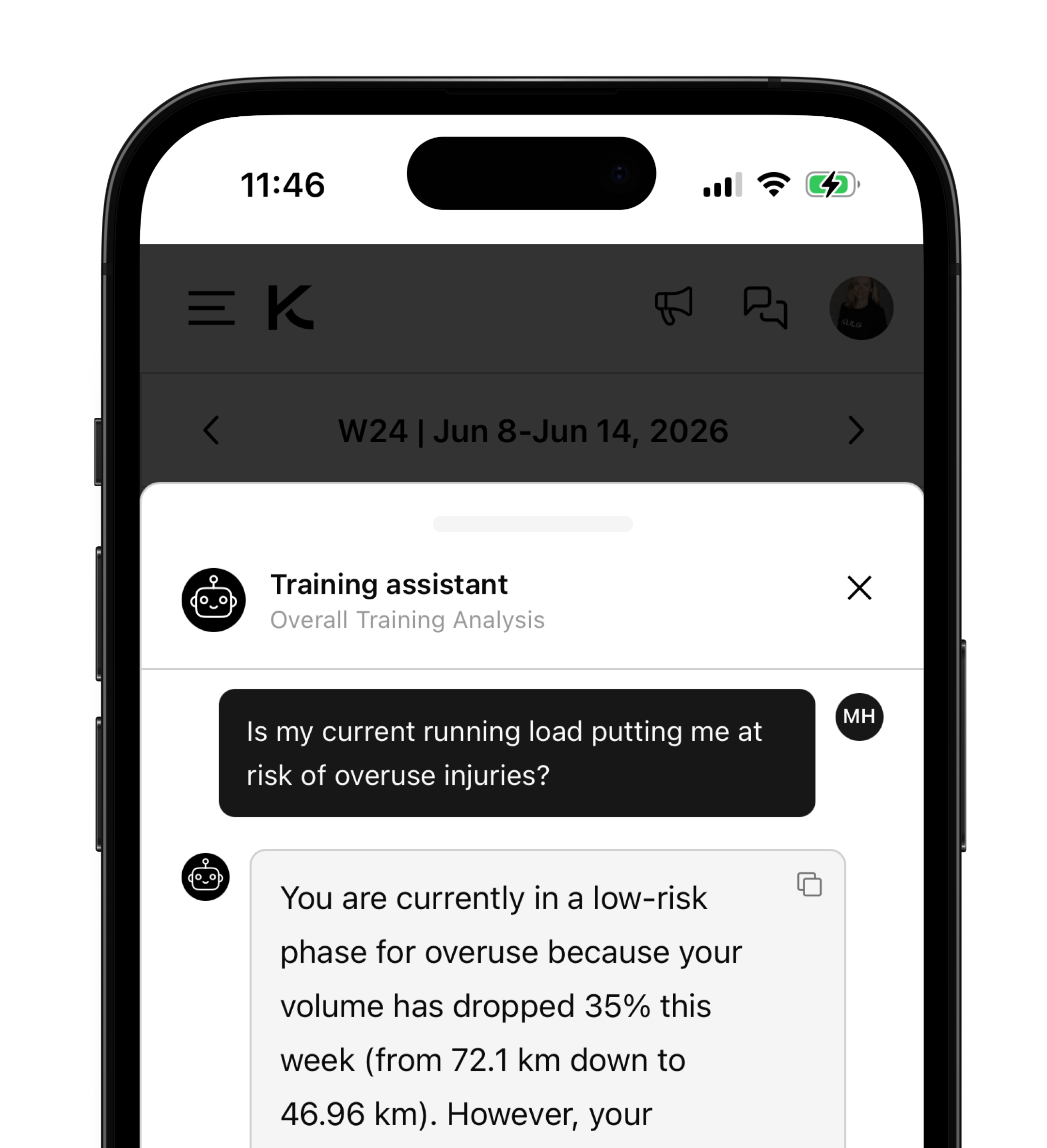
KULG Training assistant helps runners understand their training load and choose the smartest path to reach their goals
Unless there is a relevant medical condition, running is not harmful to your knees and legs when performed in appropriate doses. Understanding how overuse injuries develop and what to do differently is the first step toward preventing them. You’re already halfway there.
References
Clansey, A. C., Hanlon, M., Wallace, E. S., Nevill, A., & Lake, M. J. (2014). Influence of tibial shock feedback training on impact loading and running economy. Medicine and science in sports and exercise, 46(5), 973–981. https://doi.org/10.1249/MSS.0000000000000182
Colebatch, E. A., Fuller, J. T., Mantzioris, E., & Hill, A. M. (2025). Diet, risk of disordered eating and running-related injury in adult distance runners: A systematic review and meta-analysis of prospective cohort studies. Journal of science and medicine in sport, 28(7), 542–552. https://doi.org/10.1016/j.jsams.2025.02.001
Figueiredo, I., Reis E Silva, M., & Sousa, J. E. (2025). The Influence of Running Cadence on Biomechanics and Injury Prevention: A Systematic Review. Cureus, 17(8), e90322. https://doi.org/10.7759/cureus.90322
Huang, K., & Ihm, J. (2021). Sleep and Injury Risk. Current sports medicine reports, 20(6), 286–290. https://doi.org/10.1249/JSR.0000000000000849
Kakouris, N., Yener, N., Fong, D. (2021). A systematic review of running-related musculoskeletal injuries in runners. Journal of Sport and Health Science, 10 (5), 513-522. https://doi.org/10.1016/j.jshs.2021.04.001.
Malisoux, L., Ramesh, J., Mann, R., Seil, R., Urhausen, A., & Theisen, D. (2015). Can parallel use of different running shoes decrease running-related injury risk?. Scandinavian journal of medicine & science in sports, 25(1), 110–115. https://doi.org/10.1111/sms.12154
Nuuttila, O. P., Uusitalo, A., Kokkonen, V. P., Weerarathna, N., & Kyröläinen, H. (2024). Monitoring fatigue state with heart rate-based and subjective methods during intensified training in recreational runners. European journal of sport science, 24(7), 857–869. https://doi.org/10.1002/ejsc.12115
Leppänen, M., Viiala, J., Kaikkonen, P., Tokola, K., Vasankari, T., Nigg, B. M., Krosshaug, T., Werthner, P., Parkkari, J., & Pasanen, K. (2024). Hip and core exercise programme prevents running-related overuse injuries in adult novice recreational runners: a three-arm randomised controlled trial (Run RCT). British journal of sports medicine, 58(13), 722–732. https://doi.org/10.1136/bjsports-2023-107926
Llanos-Lagos, C., Ramirez-Campillo, R., Moran, J., & Sáez de Villarreal, E. (2024). Effect of Strength Training Programs in Middle- and Long-Distance Runners' Economy at Different Running Speeds: A Systematic Review with Meta-analysis. Sports medicine (Auckland, N.Z.), 54(4), 895–932. https://doi.org/10.1007/s40279-023-01978-y
Rethnam, U., & Makwana, N. (2011). Are old running shoes detrimental to your feet? A pedobarographic study. BMC research notes, 4, 307. https://doi.org/10.1186/1756-0500-4-307
Schuster Brandt Frandsen, J., Hulme, A., Parner, E. T., Møller, M., Lindman, I., Abrahamson, J., Sjørup Simonsen, N., Sandell Jacobsen, J., Ramskov, D., Skejø, S., Malisoux, L., Bertelsen, M. L., & Nielsen, R. O. (2025). How much running is too much? Identifying high-risk running sessions in a 5200-person cohort study. British journal of sports medicine, 59(17), 1203–1210. https://doi.org/10.1136/bjsports-2024-109380
Taddei, U. T., Matias, A. B., Duarte, M., & Sacco, I. C. N. (2020). Foot Core Training to Prevent Running-Related Injuries: A Survival Analysis of a Single-Blind, Randomized Controlled Trial. The American journal of sports medicine, 48(14), 3610–3619. https://doi.org/10.1177/0363546520969205
Wu, H., Brooke-Wavell, K., Fong, D. T. P., Paquette, M. R., & Blagrove, R. C. (2024). Do Exercise-Based Prevention Programs Reduce Injury in Endurance Runners? A Systematic Review and Meta-Analysis. Sports medicine (Auckland, N.Z.), 54(5), 1249–1267. https://doi.org/10.1007/s40279-024-01993-7